
2026 Public Policy Priorities
Community development financial institutions (CDFls) fill critical financing gaps in rural, urban, and Native communities often overlooked by traditional lenders. With over 1,400 institutions across the country, CDFls play a vital role in fostering economic opportunity by addressing real-world challenges like rising housing costs, inflation, and limited access to capital for small businesses.
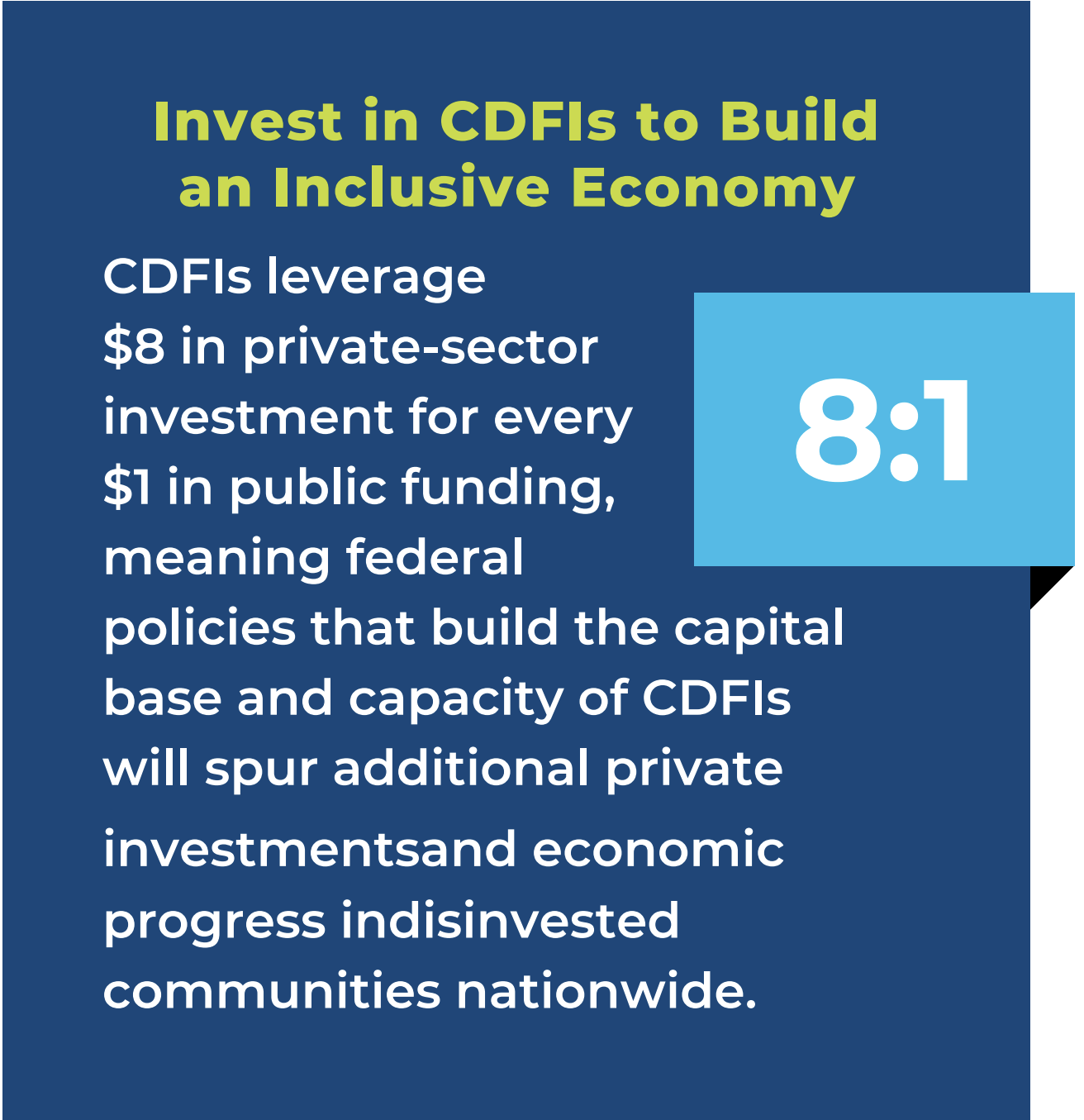
By focusing on local needs, CDFIs help create jobs, support small business growth, and finance essential services like healthcare and childcare. Through partnerships with the public sector, CDFIs effectively mobilize private capital—leveraging $8 in private investment for every $1 in public funding—to spur long-term economic growth on Main Street. This market-driven approach ensures that federal investments lead to substantial private-sector returns and stronger local economies.
OFN Policy Priorities
The CDFI Fund’s investments are a vital source of capital for CDFIs, which leverage federal dollars to attract private and philanthropic investment. Specifically, the U.S. Treasury’s CDFI Fund provides critical organizational support, enabling CDFIs to make localized funding decisions based on community-specific needs. Unlike many federal programs that direct project-level grants from Washington, DC, CDFI Fund programs invest directly at the institutional level – reducing bureaucracy and
empowering local decision-making.
Maintaining appropriations for the CDFI Fund is essential to expanding opportunity in areas where traditional lenders often do not reach. With 29% of CDFI lending directed to high-poverty areas, steady funding will ensure CDFIs can continue to attract private investment to bridge critical financing gaps. Congress should allocate at least $324 million to the CDFI Fund for Fiscal Year 2027 including increased funding for the Native American CDFI Assistance (NACA) program to maintain this key source of seed capital driving economic growth in underserved communities. Maintaining adequate staffing at the CDFI Fund is also critical to continuing vital functions like CDFI certification and the administration of the New Markets Tax Credit.
Investing in proven federal programs that combine private sector solutions and local decision-making is essential to creating lasting prosperity. With a focus on fiscal responsibility and stewardship, CDFIs help small business owners and first-time homebuyers utilize federal resources to achieve the American Dream. Expanding CDFI access to federal credit and lending programs ensures that taxpayer resources are used efficiently and effectively.
Existing federal programs have the potential to unleash even more resources to address pressing issues like the nation’s housing affordability crisis. The federal government should:
- Reform the Department of Treasury’s CDFI Bond Guarantee Program: This program offers long-term credit at below-market rates but faces high barriers to entry. Pass the bipartisan CDFI Bond Guarantee Program Improvement Act (S.1880) to make the program permanent and reduce the minimum bond size from $100 million to $25 million. This will allow more community lenders, particularly in rural markets, to participate.
- Expand CDFI involvement in USDA Rural Development programs: Programs such as the Section 502 Direct Loan Program, Rural Energy Assistance Program, and Community Facilities Program can benefit from CDFIs’ on-the-ground expertise, increasing homeownership and enhancing critical community infrastructure in rural areas.
- Enhance SBA lending programs: By partnering with CDFIs, the Small Business Administration can improve access to small dollar lending that businesses need to start, expand, and create jobs, particularly in rural and low-income areas through proven models like the Microloan program and Community Advantage program, which must be preserved and expanded.
- Promote affordable housing through market-driven initiatives: Partnering with HUD and FHFA to leverage private investment will expand affordable housing options and address the nation’s housing crisis. In particular, the federal government must ensure Fannie Mae and Freddie Mac continue to make contributions to the Capital Magnet Fund and Housing Trust Fund. Additionally, increasing the role of CDFIs in federal programs like Opportunity Zones and aligning the program with other housing initiatives such as the LowIncome Housing Tax Credit will allow CDFIs to combine these investments to amplify their impact.
CDFIs are essential partners in rural revitalization, financing projects in communities with aging housing stock and outdated infrastructure. Low-income communities are disproportionately impacted by these challenges, which burden local economies and lead to higher costs for the federal government. Strategic investments in affordable housing and resilient infrastructure help build safe, livable communities. CDFIs also act as financial first responders in the aftermath of disasters, providing swift support to small businesses, homeowners, and community organizations, especially in areas federal aid is slower to reach.
- Support key bipartisan tax incentives, including the Community Development Investment Tax Credit Act (H.R.6650/S.2963) and the Neighborhood Homes Investment Act (H.R.2854/S.1686), to encourage private sector-led revitalization of local economies, expand the supply of affordable housing, and create jobs.
- Index the New Markets Tax Credit allocations to inflation, promoting long-term private investment in lowincome and rural communities. Maximize reinvestment of capital by increasing smaller and mid-size CDFI participation in the program.
- Enhance the Low-Income Housing Tax Credit to drive rural investment through a targeted rural basis boost for Housing Credit Properties.
- Modernize USDA Rural Development Housing tools, including Section 502 Direct Loans and Section 515 Rural Rental Housing, to expand affordable homeownership and rental supply in rural and tribal communities.
- Permanently authorize and reform the Department of Housing and Urban Development’s Community Development Block Grant Disaster Recovery (CDBG-DR) program through the ROAD to Housing Act (S.2651) to better reach the needs of low- to moderate- income households following major disasters.
- Establish a National CDFI Crisis Fund to streamline emergency financial assistance for small businesses and low-income communities during declared disasters or economic shocks through the CDFI Crisis Fund Act (S.4165).
A strong financial system relies on fair competition, transparency, and responsible lending. CDFIs play a key role in ensuring small businesses and consumers have access to affordable financing, offering alternative financing options to predatory lenders. Predatory lending undermines fair competition by trapping borrowers in high-cost debt and crowding out responsible lenders. Federal policy should protect market integrity by promoting transparency and accountability in lending. Key priorities include:
- Accelerating implementation of policies that promote transparency and efficiency, like the CDFI Transparency Act (S.2704) which would promote additional oversight of the CDFI Fund to ensure federal resources are being allocated fairly and responsibly.
- Ensuring the Community Reinvestment Act (CRA) continues to drive private-sector investment in CDFIs, especially in rural areas with limited physical bank branches and a high concentration of predatory lenders where CDFIs step in to fill the gap in financial services.
- Enabling new, innovative approaches like funding the CDFI liquidity enhancement program through the Scaling Community Lenders Act (S.1442), which would allow CDFIs to scale their activities and fuel more lending in low- and moderate-income communities.
- Promoting lending policies that protect entrepreneurs from irresponsible financial products, helping to preserve a vibrant small business sector and strengthen local economies.
Featured Impact Stories

Greenville, SC
Founder Caitlin Clare turned her passion for homemade ice cream into a thriving business, inspired by her experience working at a small-town shop in Ohio. What started as a frozen cart venture grew into a brick-and-mortar establishment, even amid the challenges of the pandemic. With CDFl-backed funding from South Carolina Community Loan Fund and Appalachian Community Capital for leasehold improvements, equipment, and fixtures, Clare’s Creamery was able to launch and expand. Caitlin has since paid off her loan and continues to grow, fostering economic and social impact in her community.

Sawyer County, WI
Leveraging New Markets Tax Credits (NMTCs), the Lac Courte Oreilles Band of Lake Superior Chippewa Indians is developing a new, state-of-the-art tribal health center that will consolidate two aging facilities into one new location. Doing so will nearly double the clinic’s capacity and enable the expansion of existing services and the launch of new health and wellness programming designed to more comprehensively meet the health care needs of tribal members and other residents in the rural area.

Monticello, KY
Financing from Kentucky Highlands Investment Corporation is powering a nearly 15,000 square-foot medical facility that brings critical health services to a rural community in coal country. In 2023 the facility lost vaccines and other refrigerated medicines during a local power failure. A solar energy system with a battery backup will ensure the continuation of services, even in the event of extreme weather and power outages, and Kentucky Highlands came in with affordable financing to make the cost of reliable solar energy-and its accompanying savings-within reach.