Unlocking Ownership: A High-Return Federal Investment in Resident-Owned Communities
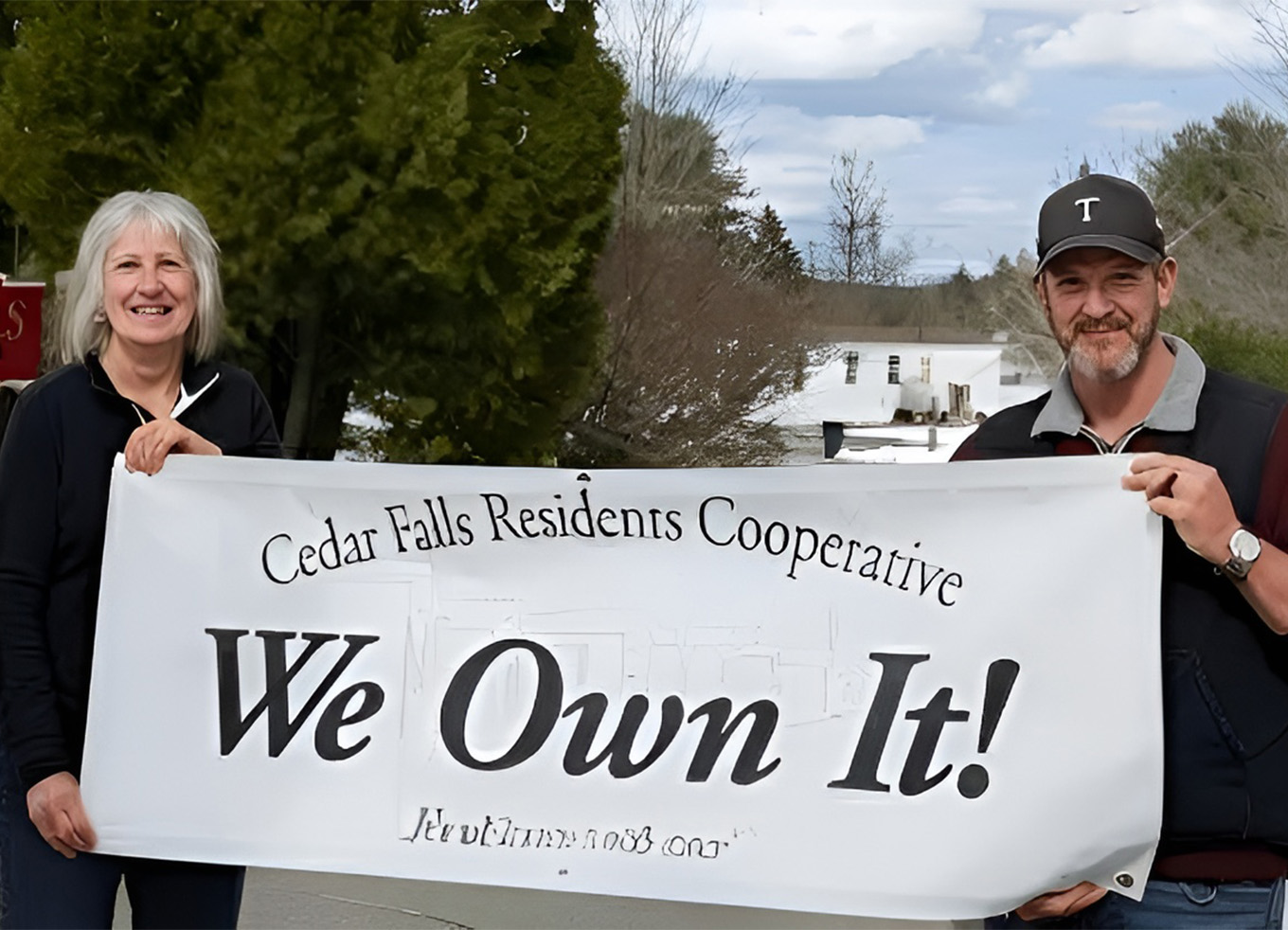
Client: Cedar Falls Residents Cooperative
Client Location: Bangor, ME
CDFI: Genesis Community Loan Fund
CDFI Service Area: Maine and northern New England
Lending, guidance, and investing in affordable housing, food security, childcare, and supportive services
With mid-winter snow falling and temperatures in the single digits, residents went door to door last year through the Cedar Falls Mobile Home Park in Bangor, Maine, a small city in Maine’s rural Penobscot County. Bundled in their coats and boots, they were organizing to purchase and save their community.
The 79-acre park, built in 1987 by a local family, was home to nearly 130 families and seniors. It had been put up for sale just a few weeks earlier.
Residents had seen from other mobile home park sales what happens when out-of-state private equity investors acquire mobile home communities: lot rents rising as much as 20 percent per year, deferred maintenance, and long-term residents forced out of homes they own. As one resident put it, “We knew this place could become unrecognizable.”
Their story is a powerful example of how federal policy, public and private capital, and mission-driven lenders can work together to unlock outcomes that mainstream finance cannot—and deliver measurable returns and stability for communities and local economies.
Vulnerable Community
Manufactured home communities represent one of the nation’s largest sources of unsubsidized affordable housing. Yet because residents typically own their homes but not the land beneath them, these communities are especially vulnerable to having little control of decisions that affect their health, stability, and future, for themselves and their families.
More than 45,000 of Maine’s residents live in mobile home communities, about 3 percent of the state’s population.
The Cedar Falls residents—including older adults on fixed incomes, veterans, people living with disabilities, and families—were highly unlikely to be able to access traditional financing to compete with a private investor’s offer. To even come close to their dream of purchasing their community, they required:
- Patient capital
- Flexible underwriting
- Coordinated public-private investment
- Deep technical assistance
- Filling the Gap
With organizing support from Cooperative Development Institute, residents first formed the Cedar Falls Residents Cooperative.
Then, Genesis Community Loan Fund, a more than 30-year-old certified nonprofit CDFI based in Brunswick, Maine, stepped in to coordinate diverse public and private investment.
To put together an $8.8 million financing package, Genesis brought in a loan from a local community bank Bangor Savings Bank, MaineHousing (the State of Maine’s housing authority), the City of Bangor (contributing federal Community Development Block Grant funds), and private philanthropic investment from the John T. Gorman Foundation in Maine.
This layered capital stack enabled residents to outbid a private investor and purchase their community on February 18, 2025.
Affordability and New Opportunities for Ownership
The purchase preserved nearly 130 affordable homes—housing that would almost certainly have become unaffordable without intervention. But because residents now own the land cooperatively, lot rents are stabilized, maintenance decisions are community-driven, and affordability is protected for the long term.
In addition to preserving existing homes, the cooperative secured 28 vacant, infrastructure-ready lots. With a $3 million loan from MaineHousing and partnership with Bangor Housing, the municipal housing authority, these sites are being developed with new manufactured homes—creating new, attainable homeownership opportunities in a market where entry-level homes are increasingly out of reach.
Residents graduating from the housing authority’s Family Self Sufficiency program will be offered a pathway to ownership, allowing them to build equity, remain with their families near jobs and schools, and stay connected to support networks.
Impact in a Rural Community
Bangor is a regional service center for rural Maine, and manufactured housing is one of the most critical sources of nonsubsidized affordable housing for rural working families and seniors across the state.
After Maine enacted its Opportunity to Purchase law in 2023, requiring park owners to notify residents when a sale is planned, Cedar Falls was the second community to successfully transition to resident ownership under the statute.
To date, since Genesis began 15 years ago to bring them CDFI capital and know-how, 13 resident-owned communities in Maine now provide stable housing to hundreds of rural households, demonstrating the scalability of this approach when capital is available.
Why Federal Investment Matters
Federal investment in CDFI lending doesn’t replace private investment: it helps make it possible.
Capital and coordination from Genesis, with its decades-long track record of financing in Maine, was essential to building the package that ultimately included private bank financing, private philanthropic investment, and additional investment from the municipal and state level.
Federal support via the CDFI Fund catalyzed this activity.
Without this kind of support, communities like Cedar Falls would likely be sold to outside investors, leading to rent hikes and displacement. And the cost of helping families after they lose their homes is far greater than the upfront investment needed to preserve affordability and stability in the first place, which is why leaders at the municipal and state level were so eager to join in the effort to preserve Cedar Falls as an affordable community.
Lives Changed
As one Cedar Falls resident leader said on closing day, “We knocked on doors, we sat in living rooms, and we made it real. We know this is ours—and we get to decide what comes next.”
With continued federal investment and policy support, this model can be replicated at a greater scale nationwide—preserving affordable homes, expanding ownership, and delivering strong economic returns for communities and taxpayers alike.
Are you an OFN member CDFI with a great borrower story to share?
Your client success stories illustrate what it means to deliver opportunity for all. They help OFN demonstrate how CDFIs work to help create good family-wage jobs, decent affordable homes, healthy foods, greener neighborhoods, and so much more.
Stay Connected with OFN
Subscribe to receive regular updates straight to your inbox and check out our blog for the latest coverage from OFN and the CDFI industry.
Follow us on social media.