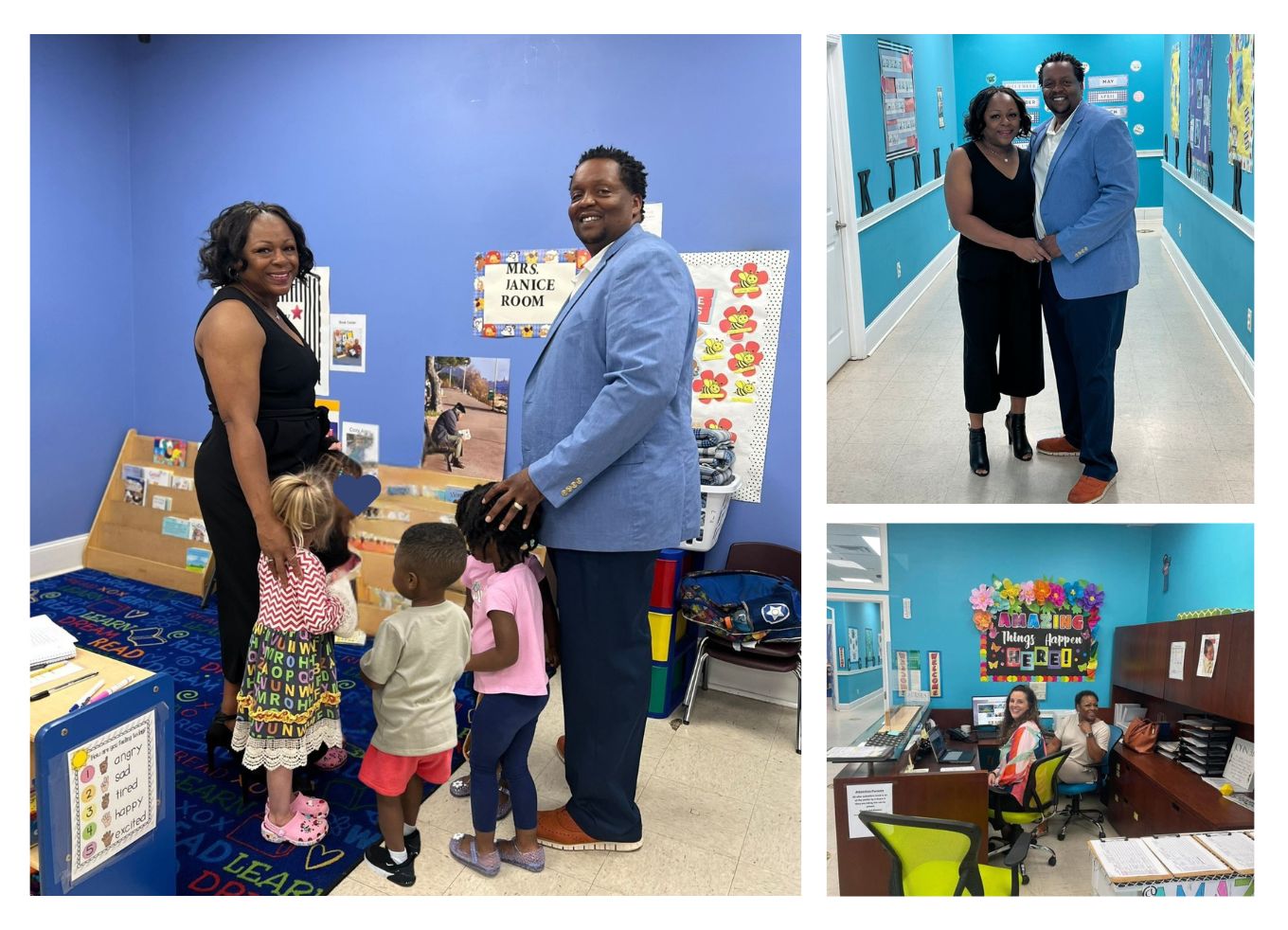
Preserving Childcare as Economic Infrastructure in Rural Mississippi
Client: Amazing Childcare and Learning Center
Client Location: Shannon, MS
CDFI: Renaissance Community Loan Fund (RCLF)
CDFI Service Area: Shannon, MS
Skills, information, and lending services to home and business owners
Vanessa and Adaniel Young set out to transform a vital community asset into a sustainable, locally owned small business: Amazing Childcare and Learning Center, an early childhood education facility located in Shannon, Mississippi, operating in a CDFI-eligible census tract. The Youngs were deeply committed to operating the business themselves, with both planning to work full-time in the center. During the early transition period, Adaniel also continued working evenings as a barber to supplement household income, underscoring their personal investment and willingness to make sacrifices to ensure the business’s success.
Their vision extended beyond ownership. They sought to preserve consistent access to quality childcare in a community with limited options, while creating long-term economic stability and employment opportunities for their family and others.
Leadership Rooted in Lived Experience
Vanessa and Adaniel are not absentee owners. Both are credentialed Early Childhood Directors, approved to accept state vouchers before the purchase closed, reinforcing their belief that this work was purpose-driven. Vanessa, a registered nurse and former owner of an adult daycare facility, brings trauma-informed leadership, rigorous health protocols, and operational discipline. Adaniel, a licensed barber of more than 20 years, brings trusted community presence and operational support. Their leadership is shaped by lived experience in which both benefited from community-based programs as children and understand firsthand how early intervention can change life trajectories.
Still, becoming first-time owner-operators required both vision and courage. To make this vision possible, they needed financing to purchase the commercial real estate housing the childcare center and to secure working capital to stabilize cash flow during the transition from the former nonprofit structure to for-profit ownership. Because the business was changing ownership structure, underwriting required a deeper analysis than a typical acquisition. Renaissance Community Loan Fund (RCLF) evaluated historical operating data from the existing daycare, modeled potential enrollment fluctuations tied to the ownership transition, and compared those projections against similar childcare facilities within RCLF’s portfolio. Complicating the transaction further, the family’s primary income would eventually be derived from the business itself, leaving no excess personal income to apply toward personal debt service, an obstacle that made conventional underwriting particularly challenging for a first-time owner-operator purchase.
The CDFI Difference
The Youngs were turned down by mainstream lenders who were unable to finance the project due to several barriers. The conversion from nonprofit to private ownership caused complications, while the anticipated cash-flow sensitivity during the transition period raised concerns that traditional loan products could not accommodate. Additionally, lenders were hesitant to finance a childcare facility in a low-income census tract, despite strong demonstrated community need and demand. As a result, the project could not qualify for traditional financing, even though the underlying business served an essential role in the local economy.
RCLF was able to meet the needs of the Youngs through a blended, mission-driven financing approach paired with intensive technical assistance. RCLF structured a flexible capital stack that combined State Small Business Credit Initiative (SSBCI) funds with FHLB–Dallas Small Business Boost (SBB) gap financing, allowing the loan to absorb early-stage cash-flow variability without placing unsustainable pressure on the business. This structure reduced upfront debt service, provided liquidity during the enrollment stabilization period, and aligned repayment expectations with the realities of childcare operations. The loan supported both the acquisition of the real estate and the working capital necessary to maintain staffing, licensing compliance, and operations throughout the ownership transition.
Equally important, RCLF partnered closely with the Youngs throughout an extended coaching process that evolved as their plans matured. Over multiple meetings and more than 90 hours of technical assistance, RCLF staff worked collaboratively with the Youngs to evaluate alternative project structures, assess feasibility, and ultimately refine the scope to a childcare-focused acquisition that aligned with both community need and financial sustainability. “They believed in us before the building was even ours,” Adaniel said.
The Youngs actively embraced this guidance, adjusting timelines, restructuring plans, and leaning into RCLF’s expertise rather than pursuing riskier, premature expansion. Following acquisition, RCLF-supported coaching further strengthened the business through new branding concepts, marketing strategy, and launch planning, helping the center establish visibility, attract families, and support early enrollment momentum.
Systemic Impact on Rural Families and Communities
RCLF’s investment preserved a critical childcare resource in Shannon while transitioning it into stable, local ownership rooted in the community it serves. The project ensured continued access to early childhood education for working families in an underserved area, supporting workforce participation and economic resilience beyond the business itself.
For the Youngs, the outcome was the successful acquisition and launch of Amazing Childcare and Learning Center as a viable, independently owned operation supported by a realistic capital structure, strengthened operations, and a clear path toward sustainability. “We didn’t just buy a center. We protected a community,” Vanessa said. “Childcare isn’t just care; it’s survival for families.”
More broadly, the project demonstrates a larger truth: when policies fail to account for the realities of low-income and rural families, CDFIs step in not just with capital, but with partnership, patience, and purpose. By pairing patient, flexible capital with hands-on technical assistance, RCLF enabled not just a loan closing, but a thoughtful, guided process that positioned the business for long-term success and preserved an essential community service where it was needed most.
Are you an OFN member CDFI with a great borrower story to share?
Your client success stories illustrate what it means to deliver opportunity for all. They help OFN demonstrate how CDFIs work to help create good family-wage jobs, decent affordable homes, healthy foods, greener neighborhoods, and so much more.
Stay Connected with OFN
Subscribe to receive regular updates straight to your inbox and check out our blog for the latest coverage from OFN and the CDFI industry.
Follow us on social media.