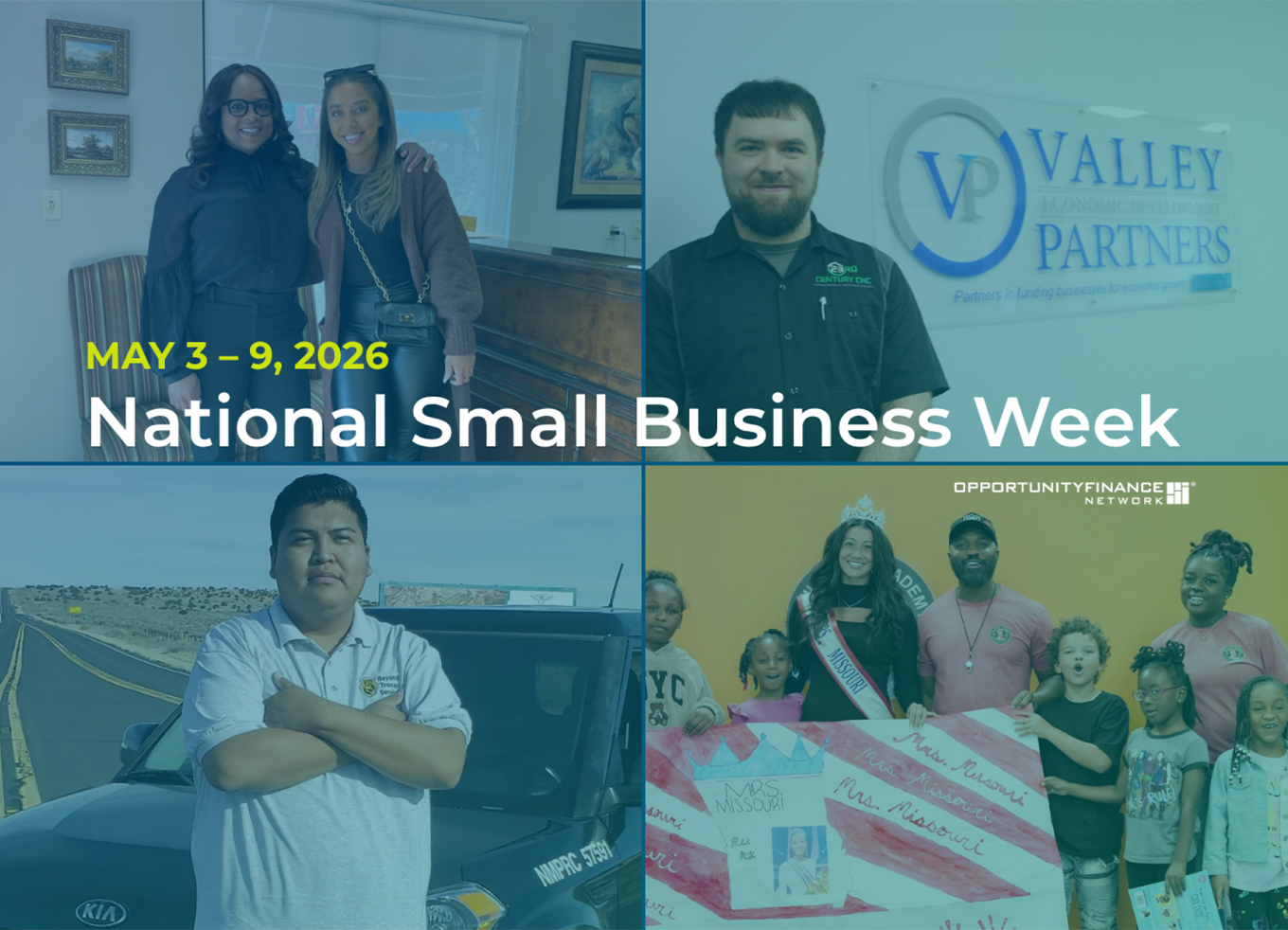
Small Business Week 2026: Four Stories of How CDFIs Build Main Street
OFN Communications Team
Read time: 5 minutes
Small businesses are economic infrastructure. They are the largest source of net new jobs in the country, the anchor of every Main Street, and one of the most reliable wealth-building pathways available to American households. National Small Business Week, marked by the U.S. Small Business Administration (SBA) since 1963, is an opportunity to recognize the entrepreneurs who keep that infrastructure running.
For thousands of those entrepreneurs, the path to capital does not run through a traditional bank. It runs through a community development financial institution (CDFI). CDFIs finance the startups others won’t, back the businesses too small for conventional underwriting, and deploy capital into the communities where market access has been thinnest. They do it with discipline. Through 2024, OFN members deployed more than $136 billion in cumulative financing, supporting 1.2 million businesses and microenterprises and helping create or maintain nearly 3.8 million jobs.
What makes CDFIs work is not the loan alone. It is the model OFN calls Capital Plus—accessible financing paired with the coaching, technical assistance, and trusted relationships that help borrowers turn capital into lasting growth. This week, we are sharing four stories from across the OFN network that show what Capital Plus looks like in practice.
LaBella’s Salon — Gulfport, Mississippi
When Julia Green wanted to grow LaBella’s Salon, she turned to OFN member Renaissance Community Loan Fund. The CDFI invested in her business with flexible financing and paired it with business coaching to put that capital to work helping her expand the salon, hire local stylists, and grow her cosmetology institute.
That combination is the point. Small businesses need more than financing to grow. They need knowledge, guidance, and a partner invested in their long-term success. CDFIs have been delivering that combination for decades, and Julia’s growth in Gulfport is a clear example of what it produces—a thriving Main Street business that serves more customers and supports more local jobs.
23rd Century CNC — Kinsman, Ohio
Jon Bancroft’s machine manufacturing shop, 23rd Century CNC, was thriving and needed to expand to meet rising demand. The local bank denied his loan because the business was relatively new and lacked the historical financial data conventional underwriting requires. OFN member Valley Economic Development Partners saw the potential the bank’s models did not. The CDFI financed the equipment purchase through a revolving loan fund, requiring just 10 percent cash down, which freed up enough working capital for Bancroft to hire the additional employees needed to run the new machine.
That is what market correction looks like at the level of one shop floor in rural Ohio. 23rd Century CNC expanded. Its economic impact on its employees and in the wider Kinsman community expanded with it. None of it required a different kind of business. It required a different kind of lender; one willing to read the opportunity, not just the historical data.
Williams Academy STL — St. Louis, Missouri
Williams Academy STL is a Montessori S.T.E.A.M.-focused school, childcare provider, and a small business. It was already navigating the financial strain of rapid enrollment growth when a tornado tore through the community it serves and damaged the homes of more than half its families.
OFN member Justine PETERSEN, a Missouri-based CDFI, stepped in with mission-driven financing. The capital allowed Williams Academy to remain financially stable and operational through both the growth and the crisis. They provided stability to the families who desperately needed it. That outcome highlights a problem CDFIs are uniquely positioned to address: Childcare businesses are essential economic infrastructure, but their entrepreneurs are routinely excluded from traditional financing on grounds of limited collateral, thin margins, and perceived risk. Justine PETERSEN’s loan closed that gap for one school in St. Louis. CDFIs around the country close it every day.
When CDFIs show up consistently, long-term growth follows.
Beyond Transport Services — Rural America
Healthcare access in rural communities often comes down to one variable: whether a patient can physically reach a provider. Quintin Yazzie’s small business, Phoenix-based Beyond Transport Services, exists to close that gap. As demand for the service grew, so did the need to grow the business.
He turned to OFN member DreamSpring, a CDFI based in Albuquerque. Its loan financed upgraded fuel-efficient vehicles and a larger client base. Today, Beyond Transport runs 10 vehicles, employs 20 people, and serves more than 60 regular clients—and Yazzie is not done yet. DreamSpring also delivered coaching to help small business owners manage finances and scale responsibly. That comprehensive approach to small business support is central to DreamSpring’s model and will be among the topics featured at the upcoming Small Business Finance Forum, cohosted by DreamSpring.
Beyond Transport’s growth is one expanding small business. It is also a measurable improvement in healthcare access for the rural community Yazzie serves. That is the multiplier CDFIs deliver.
What These Four Stories Have in Common
Different states. Different industries. Different stages of growth. The same underlying pattern: a small business with a viable plan, a traditional financing market that screened it out, and a CDFI that read the opportunity differently and invested in it with capital, coaching, and the kind of relationship that produces durable results.
That pattern is not anecdotal. It is the model. CDFIs operate where conventional underwriting leaves capital on the table, and they do so with portfolio discipline that rivals or exceeds the broader industry. The result is more Main Street businesses open, more jobs anchored locally, and more wealth built in the communities where it has been hardest to build.
Small Business Week is the moment the country pays attention to this work. The work itself runs every week of the year.
Save the Date

Join us from October 20-23 in New Orleans, LA for the 42nd annual OFN Conference!
Stay Connected
Subscribe to receive regular updates straight to your inbox and check out our blog for the latest coverage from OFN and the CDFI industry.
Follow us on social media.
More From OFN
-
House Appropriations Committee Approves $276.6 Million for CDFI Fund for FY27
The Committee maintains its funding proposal from previous years and directs all previously appropriated CDFI funding to be promptly obligated… Read More
-
Remaining $289 Million in FY25 Funds Released for the CDFI Fund, Treasury Announces Award Reforms
Following consistent advocacy from OFN in partnership with congressional champions, allies, and member CDFIs, the Office of Management and Budget… Read More
-
New Research Evaluates OFN’s Flagship Financing Program
To better understand the impact of its financing program, OFN has released a new report with interim findings from a… Read More