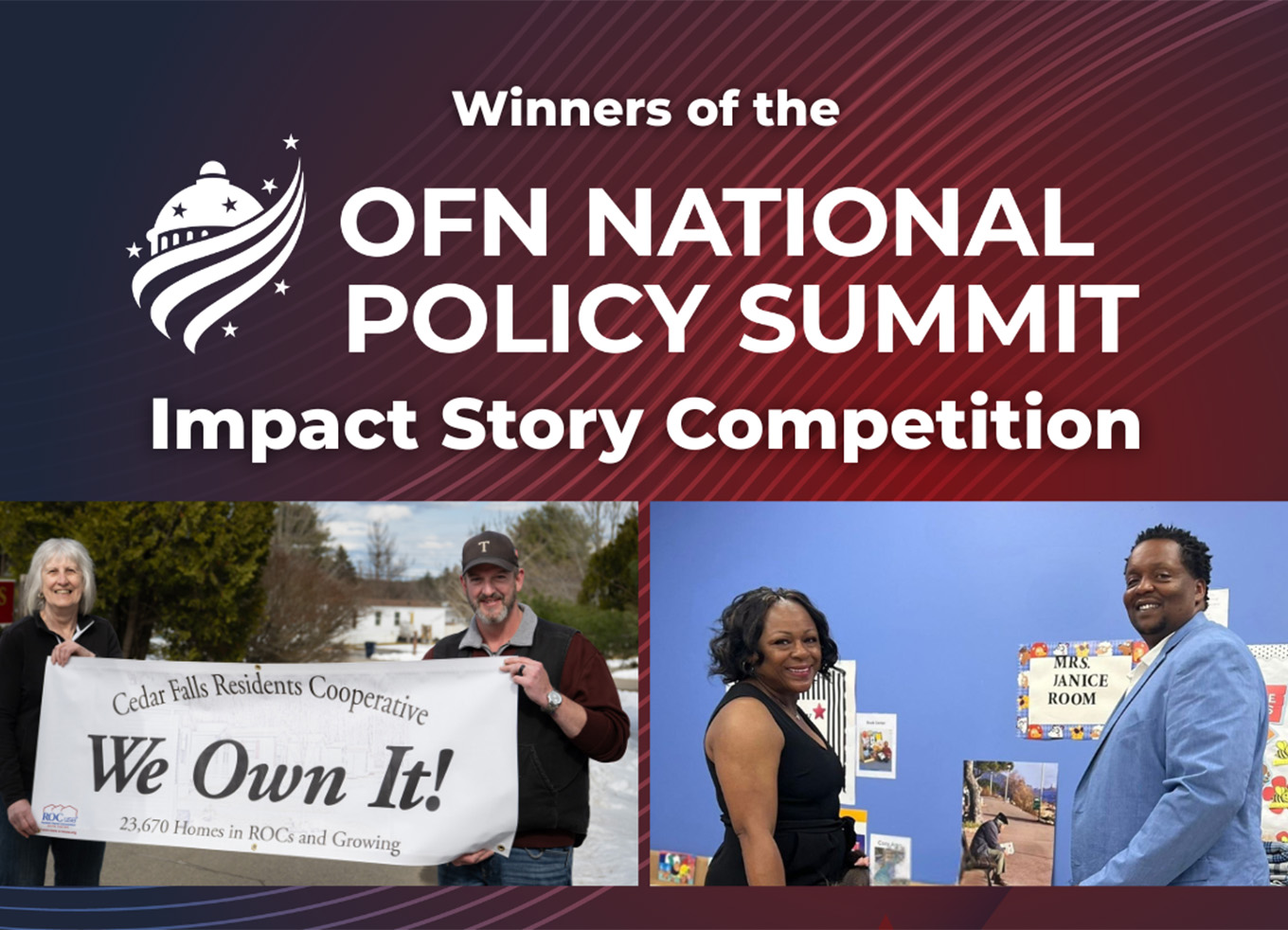
OFN to Feature Impact Story Competition Winners at Inaugural, Sold Out National Policy Summit
Compelling stories from Genesis Community Loan Fund and Renaissance Community Loan Fund exemplify CDFIs’ proven model of creating opportunity for all.
Read time: 5 minutes
We are thrilled to announce the winners of the Opportunity Finance Network’s Impact Story Competition! This competition invited CDFIs across the country to share their most compelling stories of community transformation—stories that demonstrate the power of mission-driven financing to create lasting change to bring jobs and drive economic growth in communities often overlooked by mainstream finance.
The response was extraordinary. We received 45 submissions from 18 different states, with project sizes ranging from $70,000 to $75 million. CDFIs submitted inspiring examples of how federal financing programs, combined with patient capital and flexible underwriting, are preserving affordable housing, supporting small businesses, and strengthening communities across the country.
The winners were selected based on their compelling narratives that clearly demonstrated use of federal financing programs, quantified impact metrics, highlighted a priority issue or geography, and clearly showed how CDFIs fill gaps left by mainstream finance.
After careful consideration, we are proud to recognize two outstanding winners whose stories exemplify the transformative impact of community development finance. Both winners will be featured at the inaugural National Policy Summit on February 12.
First Place: Genesis Community Loan Fund
Cedar Falls Mobile Homes Resident Owned Cooperative
When the 79-acre Cedar Falls Mobile Home Park in Bangor, Maine, was put up for sale, residents faced an uncertain future. The community—home to older adults on fixed incomes, veterans, people with disabilities, and families—understood what was at stake. They had seen it happen elsewhere: private equity acquisitions followed by rent hikes, deferred maintenance, and displacement.
In the middle of a Maine winter, residents organized door to door with a bold vision: they would purchase their park themselves.
Making this vision reality required financing not often available from mainstream lenders. Genesis Community Loan Fund, a Brunswick, Maine-based CDFI, stepped in with a comprehensive solution. Leveraging capital from the CDFI Fund’s Financial Assistance program and HUD Community Development Block Grant, Genesis provided patient capital, flexible underwriting, coordinated public-private investment, and technical assistance.
With organizing support from Cooperative Development Institute, the residents formed a cooperative and assembled an impressive $8.8 million capital stack that blended local bank financing, state and city funds, and private philanthropy. In February 2025, the residents outbid a private investor and purchased their community.
Impact at a Glance:
- 130 affordable, rural homes preserved at a fraction of new construction cost
- 28 new affordable homeownership opportunities in development
- Long-term affordability preserved with no ongoing subsidy required
- Zero resident displacement
This project demonstrates how CDFIs can support resident ownership cooperative purchases that create permanent affordability and preserve community stability and dignity.
Second Place: Renaissance Community Loan Fund (RCLF)
Amazing Childcare and Learning Center
“We didn’t just buy a center. We protected a community.” — Vanessa Young
“They believed in us before the building was even ours.” — Adaniel Young
When the longtime director of one of the only licensed childcare providers in Shannon, Mississippi prepared to retire, the center faced permanent closure. For Vanessa and Adaniel Young, this wasn’t just a business opportunity—it was a mission to preserve and strengthen quality childcare for their community.
The Youngs made significant personal sacrifices for this vision. Both worked full-time in the center, while Adaniel worked evenings as a barber to supplement household income.
As first-time owner-operators, they needed financing for real estate acquisition and working capital. But mainstream lenders declined to finance the project despite strong community need, citing ownership structure, transition risk, and the center’s location in a community with 23%+ poverty and a median area income at just 53.74% of the regional average.
Renaissance Community Loan Fund, leveraging capital from the CDFI Fund Financial Assistance Award, stepped in with a mission-driven blended capital stack. Combining federal and state financing programs like State Small Business Credit Initiative and FHLB-Dallas Small Business Boost with flexible, gap-filling financing, RCLF structured a solution that supported both acquisition and stabilization while reducing early debt service pressure during enrollment adjustment. Over 18 months, RCLF provided more than 90 hours of technical assistance and coaching to ensure a successful ownership transition.
Impact at a Glance:
- 125+ children maintain access to licensed childcare in a rural community
- Zero service disruption
- 17 jobs preserved and 2 jobs created
- 18 months of technical assistance and 90+ hours of coaching drove successful ownership transition
This project exemplifies how CDFIs fill critical gaps left by traditional lenders, supporting essential community infrastructure and first-time entrepreneurs simultaneously.
Honorable Mentions:
- Community Ventures: Home of the Innocent’s Kosair for Kids Complex Care Center
- Justine PETERSON: Yonnick Jones – Williams Academy STL
- Virginia Community Development Fund (VCDF/VCDC): Tygart Hotel
Community Development Finance: A Proven Model Creating Opportunity for All
Both winning stories illustrate important elements of community development finance’s proven model: creating opportunity for all. Through flexible underwriting that moves beyond conventional measures of risk, patient and blended capital that supports stability and growth, technical assistance that strengthens long-term capacity, and capital stacks that strategically align public and private resources, this model delivers enduring impact.
Most importantly, these stories show that when CDFIs invest in communities, they’re not just financing transactions—they’re preserving homes, protecting childcare access, creating jobs, and empowering residents to shape their own futures.
Congratulations to Genesis Community Loan Fund and Renaissance Community Loan Fund for their outstanding work. We are grateful for all the CDFIs that submitted moving stories, and while we could not award every submission, we will be using all of them throughout the year in our engagement with Congressional members and showcasing them on our blogs. These stories remind us why community development finance matters and inspire us to continue building an economy that works for everyone.
Save the Date

Join us from October 20-23 in New Orleans, LA for the 42nd annual OFN Conference!
Stay Connected
Subscribe to receive regular updates straight to your inbox and check out our blog for the latest coverage from OFN and the CDFI industry.
Follow us on social media.
More From OFN
-
House Appropriations Committee Approves $276.6 Million for CDFI Fund for FY27
The Committee maintains its funding proposal from previous years and directs all previously appropriated CDFI funding to be promptly obligated… Read More
-
Remaining $289 Million in FY25 Funds Released for the CDFI Fund, Treasury Announces Award Reforms
Following consistent advocacy from OFN in partnership with congressional champions, allies, and member CDFIs, the Office of Management and Budget… Read More
-
New Research Evaluates OFN’s Flagship Financing Program
To better understand the impact of its financing program, OFN has released a new report with interim findings from a… Read More