
Tracking Trends in OFN Member Capitalization and Sector Performance: 2019-2023
Samuel Abers, Associate, Field Building Research, OFN
Two new research briefs from OFN highlight industry trends in pandemic and post-pandemic years, showing how members raised capital and financed community needs across sectors.
Read time: 5 minutes
OFN research published earlier this year — The Business Model of CDFI Loan Funds — demonstrated that capitalization and mission-driven lending are core to the business model of loan funds. Two new briefs from OFN take a look at how these business elements — capitalization and sector specific lending — have changed in recent years among members.
The trends seen are an analysis of data from OFN’s Annual Member Survey (AMS). Since 1994, OFN has collected data from our member organizations to examine their financial health, performance, and community outcomes. As a longitudinal dataset, the AMS allows us to examine trends and provide insights that members, researchers, funders and investors, and non-OFN member loan funds may find helpful for decision-making.
Here’s what you need to know.
CDFI Capitalization Patterns
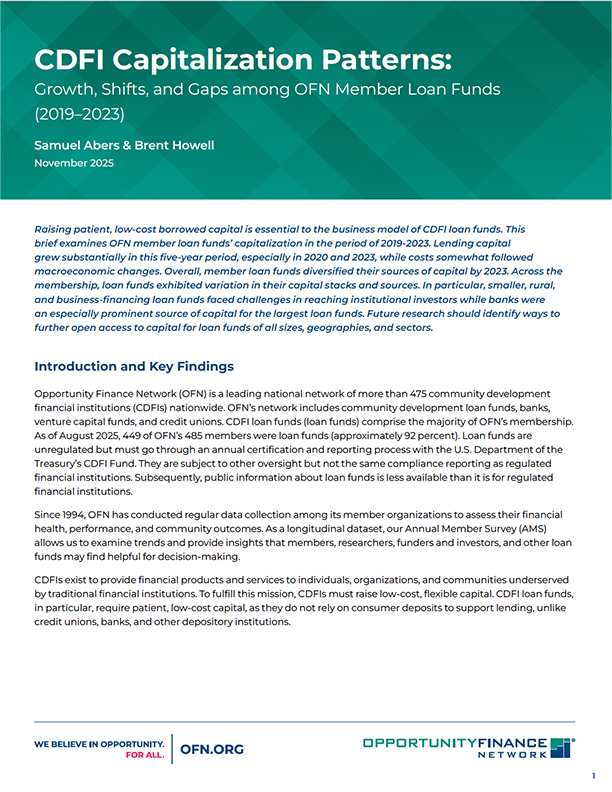
What’s the issue
Raising capital is a persistent constraint on CDFIs’ ability to meet demand, scale, and deliver to communities. In the economic crises of the early 2020s, CDFIs were able to step up by raising record amounts of capital, allowing them to emerge from the pandemic stronger than before. As the CDFI industry faces today’s uncertain capital environment, OFN research provides key context and lessons for today’s capitalization strategies within our loan fund membership.
What we learned
In CDFI Capitalization Patterns: Growth, Shifts, and Gaps among OFN Member Loan Funds (2019–2023), OFN’s research team finds consistent growth and diversification in member loan funds from 2019 to 2023. Total capital available for lending rose each year, particularly in 2020 and 2023. These increases were fueled by steady rises in net assets and high lending activity. Members drew on a wide mix of capital sources, which may have partly insulated them from macroeconomic changes in borrowing costs. At the same time, the research shows that access to capital was far from uniform: Member loan funds differed markedly in their capital stacks and sources, with smaller, business lending, and less urban members facing the steepest barriers to attracting debt from large institutional sources like banks.
Why it matters
This brief showed that while CDFIs have successfully raised capital in challenging environments, many stakeholders will be needed to maintain and broaden capital growth. This analysis helps member CDFI practitioners and leaders understand trends in capitalization strategies and develop new flexible and mission-aligned capital solutions. Investors can use insights like these to guide discussions about targeting undercapitalized areas of the CDFI industry. Future research should seek to further build knowledge of both barriers and opportunities for raising capital.
Read the research here: CDFI Capitalization Patterns: Growth, Shifts, and Gaps among OFN Member Loan Funds (2019-2023)
Sector Trends in Lending
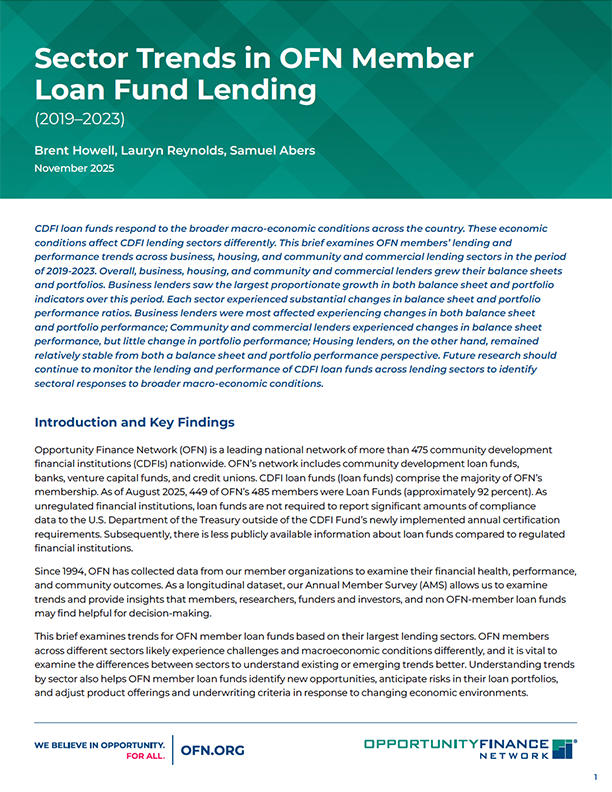
What’s the issue
CDFIs address the financial needs of the communities they serve through tailored lending strategies, often specializing in lending to specific sectors based on the needs of the community. They manage portfolios that can include businesses, homebuyers, affordable housing developers, and community-serving organizations. In the years during and since the pandemic, different CDFI financing sectors faced distinct pressures and opportunities. OFN research investigates recent sector-by-sector trends in member loan funds, providing lessons that inform CDFI lending across today’s changing economy.
What we learned
Sector Trends in OFN Member Loan Fund Lending (2019-2023) investigates how OFN member loan funds performed in business, housing, and community and commercial lending sectors in recent years. Driven in part by their role administering economic relief programs during the pandemic, members increased their lending to meet high community needs and created a strong foundation for lending in subsequent years. All sectors saw these lending changes affect their balance sheets, operations, and portfolio performance, but in markedly different ways. Borrower stress was a growing challenge for business lenders, while real estate, community organization, and housing lenders faced barriers to scale and meet high demand.
Why it matters
Industry analysis at a sector level allows members to understand their place among peers with similar challenges and histories, informing strategies in a time of uncertainty. While these industry trends inform portfolio management strategies for business-lending CDFIs, CDFIs making community organization, real estate, or housing investments need solutions to find and deploy capital sources that meet demand. Future research, investment, and strategy should continue to consider CDFIs within the unique contexts of their borrowers and lending focuses.
Read the research here: Sector Trends in OFN Member Loan Fund Lending (2019-2023)
What’s next at OFN Research?
OFN Research examines the value and impact of OFN, our members, and the CDFI industry through producing original research, creating practical resources, building knowledge, and forging partnerships. Products coming soon include updated Fiscal Year 2024 industry data from the Annual Member Survey, further briefs on the geography of lending, and other reports on key industry issues. As the national environment continues to change in ways that affect CDFIs and the communities they serve, OFN Research will continue to equip stakeholders with data, knowledge, and analysis.
Stay Connected
Subscribe to receive regular updates straight to your inbox and check out our blog for the latest coverage from OFN and the CDFI industry.
Follow us on social media.
More From OFN
-
OFN42—Call for Sessions Now Open
Call for sessions now open as OFN launches the 2026 conference. Submit a proposal. Main Street needs capital that reaches every… Read More
-
House Appropriations Committee Approves $276.6 Million for CDFI Fund for FY27
The Committee maintains its funding proposal from previous years and directs all previously appropriated CDFI funding to be promptly obligated… Read More
-
Remaining $289 Million in FY25 Funds Released for the CDFI Fund, Treasury Announces Award Reforms
Following consistent advocacy from OFN in partnership with congressional champions, allies, and member CDFIs, the Office of Management and Budget… Read More